

Market Dynamic: Latest customs data shows that in Q1 2025, China's exports of ultrasonic aroma-humidifiers to major Southeast Asian markets grew 24% year-on-year, making them a star category in smart personal care.
Demand Driver: This growth stems from the explosion of demand for "healthy ambiance management" among Southeast Asia's middle class. They are no longer satisfied with simple humidification or fragrance but seek intelligent products that integrate "ambiance adjustment, health protection, and personal expression."
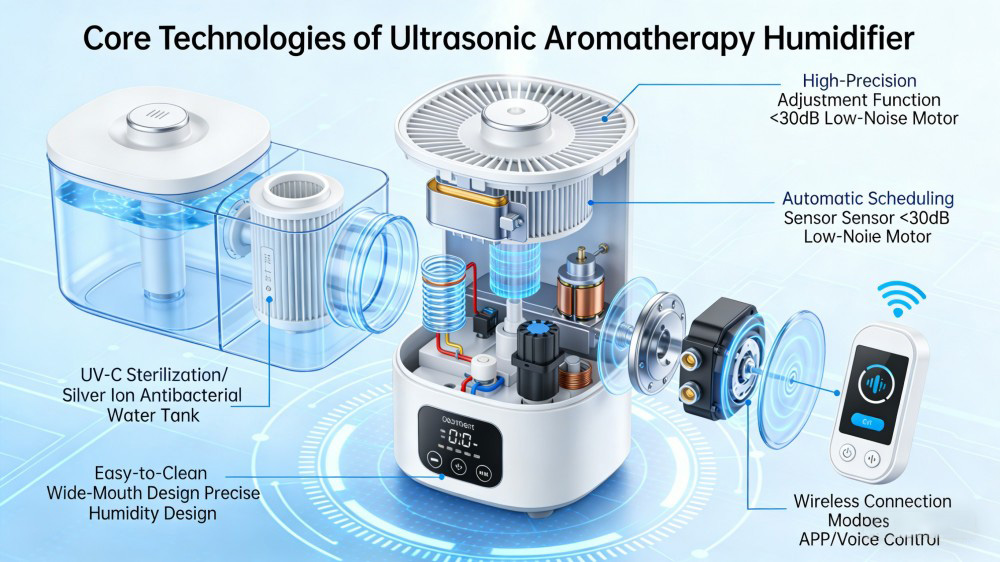
In-Depth Analysis of Technical Specifications (Based on surveys of over 50 regional buyers in Southeast Asia):
Particle Size (<3μm): This is the buyers' primary technical concern. Ultra-fine mist particles ensure even diffusion of essential oils without wetting surrounding items, are more easily perceived, and enhance the "premium feel" and safety of the fragrance experience.
Smart Humidity Sensing & Closed-Loop Control: Southeast Asia's climate is inherently humid, so buyers strongly reject products that can over-humidify indoors. Models equipped with high-precision humidity sensors that automatically adjust mist output to maintain a preset range (e.g., 50%-60% RH) are now standard for securing orders.
Low-Noise Operation (<30 dB): Buyers explicitly require products to be nearly silent for use in bedrooms and other quiet settings. This relates directly to motor quality, water pump design, and internal structural optimization, serving as a key indicator of manufacturing craftsmanship.
Water Tank Antibacterial Technology & Easy-Clean Design: High temperature and humidity easily breed bacteria. Therefore, water tanks featuring UV-C sterilization or silver ion antibacterial modules have become important selling points. Simultaneously, detachable, wide-mouth tank designs are highly favored for ease of cleaning.
Wireless Connectivity & Scenario-Based Intelligence: Control via app or voice assistant is now a basic function. Buyers place greater value on scenario modes that automatically switch fragrances and humidity levels based on time, season, or user activity (e.g., sleep, reading). This requires manufacturers to possess hardware development and simple algorithm integration capabilities.
Supply Chain Implication: The Southeast Asian market is rapidly shifting from "price-sensitive" to "tech-spec-sensitive." A manufacturer's ability to communicate technology—clearly explaining how the above specs are achieved and translated into consumer benefits—has become as important as production cost control.